Case Story — MAXXGreen Technologies: From Zero Web Presence to a Complete Brand
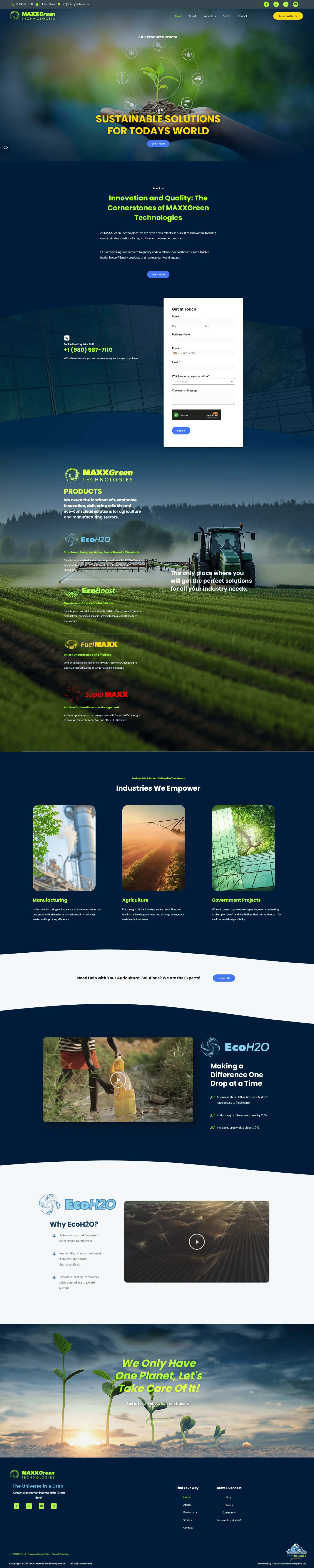
Most of our web projects start with a site that isn't working. This one started with nothing at all.
MAXXGreen Technologies had an innovative green technology product and no digital presence — no website, no brand identity, and no way for potential B2B customers to find or evaluate them online. Not a dated site. Not a neglected site. Zero.
That's a harder brief than a redesign, and in some ways a better one. Nothing to argue with, nothing to preserve out of sentiment, no legacy pages nobody wants to delete. But it also means every single decision is unmade, and the first one you get wrong costs you the rest.
Why we didn't start with the website
The instinct when a company has no site is to build a site. We think that's backwards, and we said so.
A website is a delivery mechanism. It delivers a brand. If the brand doesn't exist yet, the site becomes the place where it gets improvised — a color picked because it looked fine on the button, a logo lifted from a slide deck, type chosen by whatever the template shipped with. Six months later the business cards don't match the trade show booth, the booth doesn't match the site, and someone has to pay to redo all three.
So we started from the ground up with identity. Logo, color system, and typography, developed as one set of decisions rather than three separate favors.
The two things the identity had to say at once
Green technology has a positioning problem that anybody in the category will recognize: the visual shorthand for "environmental" is soft. Leaves, gradients, a lot of pale green, a general feeling of good intentions. That vocabulary reads as sincere and it reads as light — and light is exactly wrong when your buyer is an industrial purchaser deciding whether your product will hold up in their facility.
The brief we set for ourselves was to communicate environmental responsibility and industrial reliability at the same time. Those pull against each other, and the resolution isn't a compromise between them. It's picking which element carries which job.
That's the practical value of a color system over a color. A system gives you a primary that can hold the environmental promise, a set of neutrals with enough weight to feel like equipment rather than lifestyle, and defined rules for which one dominates in which context. The typography does similar work: a face with engineering discipline in it stops the green from floating away.
We'd rather spend that argument once, in the identity phase, than re-litigate it on every page.
Then the site, built around how B2B buyers actually decide
With the identity settled, the website had a spine to build on. Three structural decisions carried it.
Clear product pages. In B2B, the product page is the whole conversation. It's where a purchaser decides you're worth an email, and it's the page they forward to the person who actually signs. Burying products behind a general "Solutions" page is a habit borrowed from enterprise sites that already have salespeople in the room. When nobody knows you yet, the product needs its own page, its own URL, and its own argument.
An education-first content structure. This is the piece most first websites skip. A B2B buyer evaluating an unfamiliar technology is not ready to be sold to — they're trying to understand the category well enough to have an opinion. A site organized around teaching that gives them somewhere to do it, and it does something else useful: it earns the right to be found by people searching questions rather than brand names, which matters enormously for a company nobody's searching by name yet.
Strong calls to action. Education without a next step is a library. Every page had to end somewhere.
SEO-ready architecture from day one. Not as a later phase. The structure of a site — how pages relate, how they're titled, what's actually rendered in the HTML — is either built for search from the beginning or retrofitted expensively later. Retrofitting is one of the most common invoices in this business and one of the most avoidable.
What was delivered
- A complete brand identity: logo, color system, and typography
- A custom-designed and custom-built website with dedicated product pages
- An education-first content structure with clear calls to action
- SEO-ready site architecture targeting their core industry terms
Custom-designed and custom-built is worth pausing on. There was no theme underneath this, no page builder, no template with the corners sanded off. That's a choice with a cost — it takes longer than assembling one — and a payoff: the site does exactly what the strategy said it should, and nothing extra runs on it that has to be watched and patched forever.
You can see the finished work on the MAXXGreen Technologies project page.
What we'd tell you if you're in the same spot
If you're a technical company with a real product and no presence, the order of operations matters more than the budget. Identity, then structure, then pages. Doing it the other way around is how companies end up rebranding eighteen months after launch and paying for the website twice.
For what it's worth, we publish what this kind of work costs rather than hiding it behind a discovery call — brand packages start at $1,500 and web packages at $2,500 on our shop page, with the bigger builds priced above that. You should be able to tell whether we're in your range before you talk to us.
Start with a real conversation about your product
If you've got something built and nobody can find it, that's a fixable problem with a known order to it. Our free assessment takes about two minutes — tell us what the product is and who buys it, and we'll come back with an actual recommendation and a written estimate you can e-sign.
The part of this project we think about most isn't the logo or the launch. It's that a company with a genuinely good product spent a stretch of time being invisible to the exact buyers who needed it — not because the technology wasn't ready, but because nothing existed for a search result to point at. That's a solvable problem, and it stays unsolved for far longer than it should.
Project details are drawn from our own 2025 engagement with MAXXGreen Technologies. Scope: brand identity, web design, UI/UX, development, and SEO.
Tell us what you're working on — we reply within one business day with a real recommendation, not a sales script.
Get your free assessment